The night in Mexico City had that bitter taste known only to those who sleep on cold concrete. The air blew with unusual force, carrying the smell of gasoline from the minibuses and the dampness of a rain that never seemed to end. I, Mateo, a twelve-year-old boy who had learned more about life in the alleyways than in any school, was there, huddled in the shadows.
I was curled up behind a dumpster, trying to warm myself up. My feet were numb, and my stomach reminded me, with a dull growl, that I hadn’t eaten a thing all day. From my hiding place, I had a privileged view of the mansion in the Polanco neighborhood that dominated the block. It was a luxurious fortress: wrought-iron gates, lights that bathed the garden in a golden hue, and windows so immaculate they seemed like otherworldly mirrors.
Suddenly, a strange movement broke the monotony of the night. My instincts, the kind that sharpen when you live on the streets, put me on alert. Three men dressed entirely in black jumped over the side fence with suspicious agility. They moved like shadows, barely using small flashlights so as not to attract attention.
“Hurry up,” one of them whispered, his voice laced with a cold urgency. “The lady was clear: everything has to be ready before eight.”
“The lady.” The word stuck in my mind. I felt a lump in my throat.
These weren’t ordinary thieves. Thieves break in to steal things; these men carried a heavy toolbox and a roll of yellow industrial tape. They looked like professionals carrying out a specific order.
I pressed myself against the garage wall, holding my breath until my lungs burned. I was close enough to hear the echo of their words between the metal sheets.
“And the alarm system?” asked the second man, whose build was more robust.
“Disabled.” The woman paid a fortune for the codes. When he gets here, turns on the lights, and opens the garage door, everything will explode. It’ll look like a household accident, an accidental gas leak. By the time the fire department arrives, we’ll be on the other side of town.
The word “accident” rang in my ears like a gunshot. A sweet, heavy smell began to seep from the garage, mingling with the night air. It wasn’t the usual city smell; it was natural gas, concentrated, deadly. I knew nothing about engineering or valves, but I knew the smell of danger all too well. In my neighborhood, I’d seen entire families disappear because of oversights that “no one noticed in time.”
Fear screamed at me to stay silent, to sink deeper into the squalor and let the world of the rich destroy itself.
After all, what did that man owe me? But the memory of my mother, her gentle voice telling me that poverty was no excuse for cowardice, gave me an invisible push.
I bolted out into the rain. My feet splashed in the puddles as my heart pounded in my ribs. “He can’t get in. If he does, the mansion will become his tomb,” I repeated like a mantra. About three blocks away, I saw the headlights of a sleek, black car approaching. It was Julián Herrera, the tycoon everyone was talking about in the newspapers I used to keep warm.
Without thinking, I threw myself in front of the car. The screech of brakes was deafening. The driver, a broad-shouldered man, got out, furious.
“Are you crazy, kid? I almost ki:l:led you!” he yelled, grabbing my arm tightly.
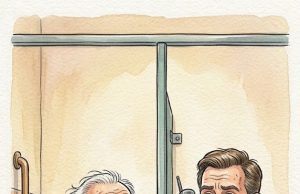
The back door opened with a solemn slowness. Julián Herrera stepped out. He wore a perfectly pressed dark suit and a watch that gleamed even in the rain. His eyes were deep and tired.
“What’s going on here?” he asked with an authority that made me tremble.
“Don’t go into the house!” I shouted, ignoring the pain in my arm. “I heard some men in his garage. Your girlfriend… she paid them. They want it to look like an accident. There’s gas everywhere. They’re going to k:ill him!”
The driver let out a mocking laugh. “Sir, he’s just a street kid. They make up these stories to get money or to get let in to steal.”
Julián looked at me intently. It wasn’t a look of contempt, but of analysis. He looked at my dirty face, my soaked clothes, and the desperate sincerity in my eyes.
“How do you know who I am?” he asked.
“All of Mexico knows who you are,” I replied, my voice trembling. “But if you go in now, you won’t make it to tomorrow.”
Julian pulled out his phone and called his personal security chief, not the local police. He asked him to check the house’s remote sensors. The ensuing silence was endless. Julian’s face, which had previously shown skepticism, turned deathly pale when he received the answer on the other end. The alarm system had been manually disabled from inside thirty minutes earlier.
Minutes later, private security units and explosives experts surrounded the property. They found the three men trying to escape through the back. They also found something worse: the main gas valve had been rigged to fill to capacity when the garage light switch was flipped.
The most painful part wasn’t the plan, but who orchestrated it. Sofia, the woman Julián planned to marry in a month, had arranged everything to inherit his fortune before he even signed a new prenuptial agreement. They caught her in a luxury hotel, waiting for news of the “tragedy.”
That night, Julián Herrera didn’t enter his house, but he did enter my life. He looked at me as I continued shivering in the rain, and for the first time, a man of his stature knelt before a boy like me.
“You saved my life, Mateo,” he said gently. “And I never forget a debt of that magnitude.”
From that day on, my life changed. Not only because Julián took charge of my education and gave me a roof over my head, but because I learned that the truth, even when spoken by the smallest and most forgotten voice, has the power to bring down the darkest schemes. The Herrera mansion still stands, but the shadow of the betrayal it harbored that night is forever etched in the history of our city.