Nobody knew how long he had been in that alley.
Maybe three days.
Maybe a week.
Maybe more.
In places like this, time isn’t measured by clocks.
He is hungry.
Cold.
With fear.
With the number of people who walk right past without stopping.
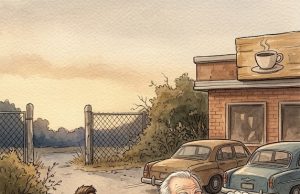
The alley was hidden behind a row of worn-out buildings.
The walls were stained.
The cracked floor.
There was accumulated garbage next to a metal bin overflowing with old newspapers, crushed bottles, and rotten food scraps.
The air smelled of dampness, metal, and neglect.
And on that broken ground, as if the world had dropped her there to forget that she existed, lay a white dog.
So thin it was hard to understand how she was still alive.
His bones stuck out like dry branches.
His belly was pressed against his ribs.
The skin seemed stretched taut over a body that had no reserves of anything left.
Not even fat.
Not even by force.
Not even hope.
But even so, she was not alone.
Clinging to his back, huddled up next to his chest, were three small puppies.
Three white balls.
Three open mouths.
Three pairs of eyes too innocent to understand the place where they were born.
They didn’t know their mother was fading away.
All they knew was that she was warmth.
That she was a refuge.
That she was the only wall between their fragile bodies and the cold ground.
The mother could not sit up properly.
Its legs were outstretched in an awkward position, as if it had collapsed and never fully recovered the ability to stand up.
Even so, he kept turning his neck.
She kept nudging her babies with her snout.
He kept trying to keep them together.
As if he still believed that, as long as they remained under his body, danger could not reach them.
A few centimeters away from her, someone had left a few croquettes.
Not many.
And she had barely touched them.
Not because I wasn’t hungry.
But because every little effort he made seemed to be reserved for a single mission.
Never stop being a mother.
That Tuesday morning, the alley started as usual.
A vendor pulling a cart a few blocks away.
The sound of an old motorcycle.
The sound of a shop door slamming shut as it opens.
Two neighbors crossing the entrance without looking down.
Nothing extraordinary.
Nothing heroic.
Nothing that foreshadowed that a life was about to change.
A few blocks away, Mateo was leaving a small cafe with a cup of coffee in one hand and a bag of bread in the other.
He was thirty-two years old.
He worked repairing air conditioning systems.
She lived life in the fast lane.
He ate quickly.
I was thinking fast.
For months she had felt that her life was just a succession of bills, traffic and tiredness.
That morning, he didn’t expect anything different either.
His truck was parked at the end of the street.
He was walking along looking at his phone when he heard a sound.
It wasn’t a bark.
It wasn’t a meow.
It was somewhat weaker.
A small squeal.
Insistent.
As if he came from a place where his voice was barely enough to ask for help.
Matthew raised his head.
He looked to both sides.
He didn’t see anyone.
He followed a couple of steps.
The sound returned.
Clearer this time.
He stopped in front of the alley.
He didn’t like going in.
It smelled bad.
There was always trash.
There were always rats.
It always seemed like one of those corners that the city prefers to pretend doesn’t exist.
But something about that sound made his chest tighten.
He peeked out.
And then he saw her.
First he saw the trash can.
Then the broken floor.
Then that very long, bony white body lying in an impossible position.
And then to the puppies.
Three.
Tight.
Looking at him.
With their mouths open as if they mistook any presence for a possibility.
Mateo felt the coffee turn bitter in his throat.
The mother barely turned her head.
Her eyes were enormous.
They had no strength.
They had no rabies.
They didn’t even have that aggressive alertness that sometimes appears in injured animals.
They had something else.
A mixture of exhaustion and pleading.
As if she were too tired to defend herself, but not too tired to keep asking that her young not be touched.
Mateo left the bag of bread on the ground.
He crouched down slowly.
“Peaceful…”
Her voice came out low.
Insecure.
The dog tried to move a paw.
He couldn’t.
He just craned his neck further over the puppies.
One of them went under her chest.
Another one just stared with his tongue hanging out.
The third one let out a sharp groan.
Mateo swallowed.
I had seen stray dogs before.
Many.
I had felt sorry for him before.
Also.
But that was different.
That wasn’t just abandonment.
It was resistance.
She was a mother reduced to skin and bones who still thought of her children first.
He took off his jacket and folded it awkwardly.
He left her close.
He didn’t try to touch her.
He took out his phone.
He looked for the number of a shelter.
They didn’t answer.
He looked for another one.
Called.
Nothing.
He tried a veterinary clinic.
They told her they could receive her if someone brought her.
He looked at the truck in the distance.
He looked back at the alley.
I didn’t know how to move her without scaring her.
I didn’t know if I would let him get close.
I didn’t know if I would make it alive.
A woman appeared at the door of a nearby building.
She was thin, with gray hair tied back and an apron stained with flour.
I had heard Mateo talking on the phone.
“He’s been there for two days,” he said.
Matthew looked up.
“Two days?”
The woman nodded.
“At first she was standing. She was looking for food in the garbage. Then she couldn’t get up anymore.”
“Did nobody do anything?”
The woman lowered her eyes.
“I left them kibble. Another neighbor left water. But when we tried to approach, he started crawling all over the puppies. He thought we were going to take them away.”
Mateo felt a pang of shame.
Not because of him.
For everyone.
Because of the tendency cities have to make compassion optional.
He moved a little closer.
The puppies raised their heads at the same time.
They were small.
Too clean compared to their mother.
Too alive.
Too confident.
That was the most painful part.
They still didn’t know how close they were to disaster.
Mateo opened the bag of bread.
He broke off a small piece.
He placed it near the mother.
She smelled it.
He didn’t even try to eat it.
Instead, she turned her face towards one of her babies and licked its head with a heartbreaking slowness.
“God…”
The woman in the apron moved a little closer.
“I don’t think he’s eaten since yesterday.”
Mateo made a decision without thinking too much about it.
“I’m going to take them.”
“Just you?”
“Yeah.”
The woman hesitated.
“It’s going to be difficult for you.”
He nodded.
I already knew that.
But sometimes a decision isn’t made because it’s easy.
It’s taken because continuing to look would be worse.
The woman disappeared for a few minutes and returned with an old sheet.
Mateo went to the truck and returned with an empty toolbox, a towel from the back seat, and a bottle of water.
He knelt beside his mother.
“I need to help you. I’m not going to take your babies away from you.”
She blinked slowly.
His breathing was short.
Fast.
As if every inhalation cost him a war.
Mateo moistened his fingers and brought a little water to his snout.
The dog barely licked it.
Once.
Then another one.
Then he covered the puppies with his head again.
That gesture was enough to destroy any remaining emotional distance.
She was no longer “that bitch”.
He was someone.
A mother.
A survivor.
Mateo and the woman carefully slid the sheet under her body.
The dog trembled.
One of the puppies yelped.
Another one tried to climb onto his neck.
The mother made a low sound.
Non-aggressive.
Supplicant.
Matthew understood immediately.
“Don’t separate them.”
They took the three puppies and placed them first on the towel inside the makeshift box.
The mother watched them.
His whole body wanted to move.
He couldn’t.
Then Mateo put his arms under his bony torso.
He felt how little he weighed.
It was terrifying.
I wasn’t carrying an adult animal.
He was carrying the remains of one.
He lifted it with infinite slowness.
She didn’t try to bite.
He did not try to escape.
She just craned her neck towards the box where her babies were.
Mateo settled her next to them.
The moment she touched the towel, the mother made an immense effort to get closer to the puppies.
Even in that state.
Even so.
He continued to place himself between them and the world.
The walk to the clinic was a tense silence.
Mateo was driving with one hand.
With the other hand, he held the box from the passenger seat.
Every bump made him clench his teeth.
Every little moan from the box made his heart race.
“Almost.”
He didn’t know if he was talking to them or to himself.
They were received in a hurry at the clinic.
The veterinarian on duty was named Elena.
She had a messy ponytail and dark circles under her eyes from several sleepless nights.
When he saw his mother, his expression changed instantly.
“Take her inside.”
An assistant took the puppies.
Another one prepared a thermal blanket.
Mateo tried to follow them, but Elena put a hand on his arm.
“Let us work.”
“Is he going to live?”
The question came out too quickly.
Too naked.
Elena did not lie.
“Don’t know.”
That was worse than a comfortable lie.
Because it was true.
And sometimes the truth weighs more.
From the waiting room, Mateo saw movement behind the door.
Serum.
Gauze.
Trays.
The woman in the apron, who had decided to accompany him, sat down next to him with her hands clasped in her lap.
“What’s your name?” she asked.
“Matthew.”
“I am Clara.”
He nodded.
They didn’t speak for a while.
It wasn’t necessary.
There was a kind of waiting that turned strangers into allies without the need for explanations.
Elena came out an hour later.
Her gown was stained.
The serious face.
But not devastated.
That was something.
“The mother is in a critical state of malnutrition and dehydration,” he said.
Mateo felt his body stiffen.
“But it keeps reacting.”
“And the puppies?”
“All three are alive. Weak, but alive.”
Clara put a hand to her mouth.
Mateo let out a breath as if he had been holding it in since he entered the alley.
Elena continued.
“We believe she gave birth recently. Very recently. Her body has no reserves. She is producing milk almost purely by instinct.”
Mateo closed his eyes for a moment.
It wasn’t a medical phrase.
It was a sentence of love.
Pure instinct.
Pure sacrifice.
Pure endurance.
“We need to admit her,” Elena said.
Mateo nodded.
“Do whatever it takes.”
The doctor looked at him with the awkward professionalism of someone about to broach the inevitable subject.
“It’s going to cost money.”
Mateo laughed humorlessly.
Clear.
Always.
The price.
The figure.
The barrier.
“Tell me how much.”
She told him.
It was not a small sum.
For him, it meant postponing payments.
Move savings.
Cancel things.
Maybe ask for help.
Mateo looked at the closed door.
He thought about the coffee he had bought that morning.
In the bread.
In their routine.
How close he had come to continuing to walk.
He took out the card.
“Begin.”
Clara looked at him.
“I can contribute something too.”
Matthew shook his head first.
Then he looked at her more closely.
The woman’s eyes were moist.
He wasn’t speaking out of obligation.
She spoke because she too had been affected by that scene.
“Then we’ll do it together,” he said.
That’s how it all started.
With an improvised box.
An old sheet.
A card passed with fear.
And two people refusing to let the city continue deciding who deserved another chance.
The first twenty-four hours were fragile.
The mother barely lifted her head.
The puppies needed constant warmth.
One of them couldn’t get a good grip to eat.
Elena and her team took turns.
Matthew kept coming back.
Clara was carrying blankets.
A receptionist created a post.
Then another one.
The story began to move.
Not with the empty speed of morbid curiosity.
But with the rare power of something that touches a real nerve.
A skeletal mother was found next to a garbage dump with three newborn puppies.
They need support.
People responded.
Small amounts.
Messages.
Food bags.
Promises of help.
A teacher brought special milk.
A delivery driver donated blankets.
A teenager emptied her piggy bank.
A man wrote that he had no money, but could offer transportation when needed.
The city, the same one that had passed by, slowly began to look.
On the third day, the mother opened her eyes more clearly.
Elena was checking on the puppies when it happened.
One of them let out a small squeal.
The mother immediately turned her head.
Not with fear.
Carefully.
With presence.
I was coming back.
“That’s a good sign,” Elena said.
Mateo felt a lump in his throat.
“Will he be able to walk?”
“I don’t know yet.”
That difficult truth again.
But this time there was something more.
One possibility.
They decided to call her Snow.
Because of its color.
Because of the way it seemed to have melted onto the ground that first day.
And because, despite everything, there was something clean and fierce about their love.
The puppies also received names.
Light.
Timo.
Breeze.
Clara insisted that names mattered.
“When something has a name, it’s harder to forget it.”
He was right.
The second week brought the first small miracle.
Nieve ate a whole portion by herself.
Not much.
But that’s enough.
Then he drank water without help.
Then she allowed an assistant to lift Brisa to weigh her without panicking.
None of that would seem extraordinary out of context.
But there.
After that alley.
After that motionless posture next to the garbage.
It was immense.
Matthew was present when he first tried to stand up.
He joined with difficulty.
The front legs trembled.
The rear wheels hesitated.
The body seemed to split in two from weakness.
And yet he managed it for a few seconds.
Enough to take an awkward step towards the puppies.
Enough to remind everyone who he was.
Not a victim.
A mother.
When he lay down again, Mateo had to dry his eyes with his sleeve.
Elena pretended not to see it.
Clara didn’t fake anything.
She cried openly.
Time continued to move forward.
Slow.
Imperfect.
But he moved forward.
Nieve began to regain weight.
His fur no longer looked so dull.
The puppies, with rounder bellies, began to play among themselves.
First they stumbled.
Then they would gnaw on blankets.
Then they tried to climb onto their mother, who watched them with a weary and beautiful patience.
There were bad days too.
An unexpected vomit.
A power outage.
A tense early morning due to fever.
But they were no longer alone.
That was the big difference.
There was no alley anymore.
There was no trash can.
There was no cracked ground beneath a mother who expected to die without letting go of them.
There were hands.
Shifts.
Awake gazes.
There were people asking about them.
That he was coming back.
That he was staying.
A month later, Elena said what everyone had been waiting for.
“They will be able to leave the clinic soon.”
Mateo felt joy and fear at the same time.
“Where to go?”
Clara looked at him even before he finished the question.
I knew what he was thinking.
“They could go to a foster home,” Elena suggested.
Mateo remained silent.
He lived alone.
His apartment wasn’t big.
His schedule was complicated.
Up until that moment, his life had been ordered for a single person who came in late and slept little.
But none of that sounded the same anymore.
Not after Snow.
Not after that alley.
Not after discovering that there was still a part within him capable of stopping.
“They will come with me,” he said.
Clara smiled as if she had been waiting for that phrase for weeks.
Elena raised an eyebrow.
“All?”
“All.”
Mateo’s house was small.
But clean.
And above all, safe.
He bought a big bed.
A pen for the puppies.
New dishes.
More food than I remember ever buying.
The first night, Nieve didn’t sleep at all.
Every noise made her lift her head.
Every step Mateo took down the hallway made her tense up a little.
But he was no longer running away.
He no longer dragged his body over them in desperation.
He was just keeping watch.
I still didn’t know how to live without fear.
That also takes time.
The puppies, on the other hand, adapted with almost insulting speed.
They discovered the corners.
They chased socks.
They became entangled with each other.
They transformed the room into a whirlwind of tiny legs and new energy.
And in the midst of that sweet chaos, Nieve began to change.
The first sign was minimal.
One afternoon, Mateo sat on the ground some distance away.
I didn’t have any food with me.
It wasn’t wearing a leash.
He didn’t try to touch her.
He just sat down.
Nieve watched him for a long time.
Then he took two steps closer.
He lowered his head.
And he rested his snout on his knee.
It was just a second.
But to Mateo it seemed a silent victory over all the damage other humans had inflicted on her.
As the months passed, the puppies grew up healthy.
They became curious.
Strong.
Ridiculous.
Nieve regained muscle.
His column no longer seemed like an impossible line.
His eyes were no longer sunken in the same sadness.
She remained cautious.
It always would be a little.
But now he also knew how to relax in the sun.
Sleep peacefully.
Eating before everyone else because there was no need to sacrifice oneself to the point of disappearing.
Sometimes, when Mateo saw her lying in the yard while the three of them played around her, he mentally returned to the alley.
Into the trash can.
To the scattered croquettes.
That almost lifeless body still pushing her babies towards her chest.
And he understood something he had previously ignored.
Love doesn’t always come across as beautiful.
Sometimes it’s dirty.
Skinny.
Cracked.
Thrown next to the trash.
Sometimes it smells bad.
Sometimes it’s scary.
Sometimes he doesn’t even have the strength to hold up his head.
But it’s still love.
And when it’s a mother’s love, it can become more stubborn than hunger.
Stronger than abandonment.
Greater than misery.
The people in the neighborhood began to learn the story.
Clara would visit them with bread rolls and news.
The clinic receptionist became friends with Mateo.
Elena received photos of the puppies asleep in absurd positions.
Several people inquired about adoptions.
Mateo decided to wait.
He didn’t want to rush things.
There was something sacred about the fact that this family had come together to that point.
I wasn’t going to break it in a hurry.
One autumn afternoon, months after the rescue, Mateo took Nieve and the three grown puppies for a walk in a park.
It wasn’t a fancy park.
It didn’t matter.
There was grass.
There were trees.
There was space.
Nieve advanced slowly, smelling everything as if the world were new.
The puppies ran ahead.
Clara was beside him, laughing at everything.
On a bench, a little girl pointed excitedly.
“Look, Mommy, what a beautiful family.”
Mateo turned his head towards Nieve.
She looked at him too.
And for the first time, he did not see a plea in her eyes.
He saw calm.
A hard-won calm.
Built.
Defended.
And that was the real difference.
Not that they had rescued her.
Instead, they had come to believe that they could stay.
People often ask at what point a story changes.
Many believe that it changes when the rescue appears.
When the clinic door opens.
When someone pays the bill.
But not.
The story changes much earlier.
It changes at the exact moment someone stops walking by.
It changes when a person hears a faint cry in a dirty alley and decides to stop.
It changes when compassion stops being an idea and becomes action.
Nieve would have given her life for her cubs.
There is no doubt about that.
It was fading away while still covering them with its body.
While continuing to choose them over any possibility of relief.
But sometimes even the fiercest love needs help.
It needs hands.
It needs time.
He needs someone to answer.
That day, in a corner that smelled of garbage and neglect, a mother did her part.
He gave it his all.
And one city, albeit late, finally decided to do its own thing.